Showing posts with label research. Show all posts

Saturday, June 06, 2015

June 2015

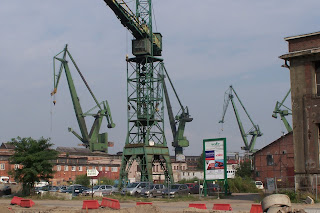
I walked down to an almost-deserted UWS Paisley campus this afternoon to pick up photocopies and materials for our Govan-Gdansk symposium on Monday and Tuesday; the rest of the university seems to be packing up for the summer holiday but the pace of events and activity is still pretty relentless in my world. We're welcoming a group of activists, academics, artists and civic leaders from Glasgow and Gdansk for the first workshop for our Royal Society of Edinburgh - funded research networking project. This will be followed up by the third Gdansk Shipyard Summer School at the start of August. Govan (and specifically, Water Row and the Graving Docks) is one of the sites that we have selected for our AHRC Connected Communities large grant proposal: Challenging Elites: rethinking disconnection and recovering urban space. That went in last week, and will now be chewed over by peer reviewers: we will hear if we've got through to the next stage in September. Whatever the outcome, it has been a useful and productive process and has enabled the team to crystallise some thinking about 'austerity urbanism', elite theory and the cultural politics of contested urban sites. It would be great if we get the opportunity to put some of the ideas we have developed into action.


Working with Remco de Blaaij, the Curator at CCA Glasgow, I have organised the first of a series of workshops/seminars in the run-up to an exhibition in 2016, which will happen on 19th and 20th of June. The 2016 exhibition, provisionally titled The Image Event,  will examine the relationships between journalistic practices, contemporary arts practices, politics and citizen/social media. For this first workshop, we're delighted to be welcoming Eliot Higgins of Bellingcat to Glasgow, for screenings, presentation and discussion with Joanna Callaghan (University of Sussex) and my UWS colleague Peter Snowdon. It promises to be a stimulating evening: tickets can be booked here.

Drawing on work I did a decade ago, I'll be contibuting to an RSA symposium on Creative Apprenticeships in Manchester on 23rd June. I need to do some more thinking about how the 'creative learning' agenda has mutated/evolved in a possibly more hostile policy environment (at least, south of the border) and this might just be a stimulus for that. Then, back in Ayr on the 24th June we will be hosting a small psychogeographic adventure as a workshop for the Scottish Graduate School for the Arts and Humanities Summer School, which will be led by our erstwhile PhD student, now Dr Ben Parry. (Ben and I are also working on a book which draws on the marvellous range of presentations from the Cultural Hijack Contravention at RIBA, which we hope will see the light of day towards the end of 2016).

Finally, before taking a couple of weeks off, most of which will probably be spent dealing with a garden and a house that has got massively out of control, Kerrie Schaefer and I are presenting at the Community Development Journal 50th Anniversary Conference at the University of Edinburgh. We'll be talking about the messy and pragmatic (but also political and ethical) negotiations that take place in community media/film practices, drawing on work from the Remaking Society project. Kerrie and I are also presenting later this year at the "Poor Theatres" symposium in Manchester; drawing together some work on deprivation, austerity and community performance (which also links to the work that Ben Parry has done on the politics of representing poverties in Dharavi, as well as the films that Hugh Kelly and I are continuing to unpack together). But that can wait for another post.


Tuesday, April 29, 2014

Update on 2014

In between all the rushing around and trying to carve out space to think and write and do stuff this blog has been rather neglected. Anyway, here is a quick update on various projects I'm attempting to keep in motion at the same time.

1. Remaking Society has ended but there is still some more 'output' that has yet to come to the surface from the project. Here's a short film that Hugh Kelly and I cut together which reflects on his 30 years of working in 'communities on the edge' in North Tyneside. We're going to write a longer reflective piece that comes out of this, hopefully to be published in one of the publications on 'Media at the Margins' that is coming out of the MECCSA conference earlier this year. In the meantime you can read the working paper that we produced for an AHRC Connected Communities symposium on social justice and co-produced research in November 2013 over at academia.edu.


The Odd Numbers project with Lee Ivett (Baxendale) and Nicola Atkinson (NADFLY) in Milton continues - we took the participatory pavilion to Room 13 in Caol, Fort William for a joint seminar/workshop with the UWS MEd Artist Teacher programme in February and we are planning a further pavilion to be developed for events later this year. There will be a book - and a ceremonial burial of the figures - later this year.  There are also some other chapters in other publications, co-authored with Kerrie Schaefer, Tom Wakeford and Neill Patton, that should see the light at the end of the year.

2. Following on from the Cultural Hijack extravaganza last year, I'm contributing to a project which UWS doctoral researcher Ben Parry is leading - The Experimental City - which seeks to build on the idea of the 'user generated city' (a term originated by URBZ in Dharavi, Mumbai) and how this is generated through live experiments in urban design, cultural interventions, and symbolic forms of occupation. There will be a book, a series of events and possibly even a film...

3. With Angie Bual of Trigger and the excellent theatre makers Davey Anderson and Gary McNair, together with Ben Colburn, Lecturer in Philosophy at the University of Glasgow, we've just launched Flip Side - a project which seeks to explore the philosophical ideas sitting underneath the independence referendum debate. More on the project here:


4. I'm just back from a few days at Columbia College in Chicago and an excellent songwriting residency hosted by Gary Yerkins, who runs the programme in Contemporary, Urban and Popular Music there. There will be an album made of some of the wonderful music that has come out of the songwriting workshops which were initiated by my colleague Davie Scott who runs the MA in Songwriting and Performance at UWS. It's great to see some of the UK-US conversations that I began more than a decade ago lead to direct transatlantic collaborations between students. Surely more to follow.

5. I'm involved in a small way in another Connected Communities "legacy" project led by Kate Pahl and Steve Pool at the University of Sheffield, examining the roles that artists have played across the programme - in some ways this builds on the work that I did as part of the TAPP (Teacher Artist Partnership Programme) project - but translates these questions a little more broadly into a wider debate about artists' pedagogies, practice-led research and the role of artistic-academic dialogues - and the kinds of spaces in which these might happen -  in generating productive frictions that might open up enquiry.

6. I went to the AHRC research development workshop on exclusion, disconnection and division in March 2014 and came out with an interesting consortium of people developing a large project with the provisional title: Challenging Elites: Land, Rights, Resistance.  More on that when we know whether our proposal for a development grant has been successful...

7. Another ongoing research theme is about pedagogies for a networked and connected age - something akin to the work that is going on, in a more thorougly developed fashion, in the big MacArthur project on digital learning. Here's a presentation I did the other week for a group of staff from UWS and other Scottish universities. One of these days I will write all this up properly into some sort of publication/provocation:


Thursday, October 18, 2012

Discourses and difficulties

This autumn's schedule has got fairly frenetic. A couple of talks coming up, both of which are a bit introspective, in the sense that they try to analyse the dynamics and discourses that underpin the way we're framing our curriculum and our research in the School of Creative and Cultural Industries at UWS. On Tuesday I'll be in London at the MECCSA Practice Network's conference at the University of Kingston discussing the approach to practice-based research in the dreaded REF (Research Excellence Framework) that we are attempting to take. Here's the quick abstract: 

Shaping our Submission: Interdisciplinarity, practice and the spaces 'in between'

The School of Creative and Cultural Industries at UWS has evolved from being a small undergraduate-focussed media school to a more ambitious operation with an increasing volume of research output and knowledge exchange, encompassing digital art, performance, and film/broadcasting/journalism practice alongside established work in media and cultural studies. Using some examples of work from researchers in the School, I will explore some of the dilemmas and difficulties we face in positioning our submission within UoA 36, which for reasons of critical mass and impact we are concentrating on for this REF. I'd welcome suggestions for appropriate strategies to deal with the difficulty of accounting for research which falls in between REF categories and criteria. 

Then in a couple of weeks I travel to Lapland for the World Alliance for Arts Education summit, where I'll be presenting a paper with the following title:

Education for cultural practice/education for cultural economy? Intersections, interdisciplinarity and issues


The School of Creative and Cultural Industries at the University of the West of Scotland (UWS) has grown rapidly in recent years in response to a government-led agenda of widening participation in higher education. UWS is a multi-campus institution that has its roots in a vocational, polytechnic approach to higher education but its ambitions are not limited to vocational training: in common with other ‘post-1992’ institutions in the UK it offers higher degrees, Masters programmes and conducts significant academic research.

Economic studies repeatedly emphasise the scale and significance of the Scottish creative and cultural economy, but these claims are contested and contingent, and beset with definitional problems.  The notion of creative/cultural employment, which is frequently flexible, freelance or network-based does not fit neatly into the definitional categories used by statisticians. The apparent divide between professional and participatory activity in the field of culture is also  problematic and contested.  Through partnership-based pedagogies and careful project design involving professionals from outside the university, the School seeks to offer students, many of whom are first-generation entrants to higher education, immersive opportunities to undertake cultural practice in professional settings. The model could be seen as a hybrid of polytechnic university, art school, and research institute.

What is at stake when we operate within these rhetorics and discourses of creative economy? Using examples from the range of work undertaken by the School I will explore some of the conflicts and collisions  in practice-based research, which combines vocational awareness with critical and cultural theory.

Hopefully these will also see the light of day as journal articles before too long. 


Wednesday, December 14, 2011

Remaking Society

Just heard that the Connected Communities 'pilot demonstrator' bid to AHRC submitted jointly with Tom Wakeford and Kerrie Schaefer has been successful. We'll set up a separate project blog in due course, but here's the summary of the project. Some fantastic partners for this project, including Mission Models Money, Cadispa Trust, NHSGGC, Theatre Modo, Bradford Community Broadcasting, Swingbridge Media, Love Milton and the inestimable Jon Hawkes. All very exciting. 


Remaking Society
Realising the potential of cultural activities in contexts of deprivation


Remaking Society will exemplify the central themes of the Connected Communities Programme via three inter-dependent routes:

i) Working with local partners in demonstrating and assessing participatory cultural
activities in four contrasting contexts of deprivation – Bradford, Glasgow,
Fraserburgh and Newcastle.
ii) Using these four pilots to generate new forms of evidence about the lived
experience of poverty and exclusion.
iii) Creating opportunities for marginalised and less visible sections of society to
communicate with wider audiences, including policy-makers.

Research context and rationale
Cultural dimensions of regeneration – making, creating, performing and celebrating – are
often neglected. Yet these aspects can be vital to the sense of shared wellbeing, belonging
and aspiration for community members. Hawkes calls the integration of a cultural
perspective into the planning of change the “fourth pillar” of sustainability, alongside
economic, social and environmental dimensions. He suggests that cultural projects provide “avenues for the expression of community values…[that can]…directly affect the directions society takes” (Hawkes 2001).

Recent Government-commissioned research has added to a growing body of evidence
suggesting that participatory arts and media processes can act as portals to wider processes of social development, by offering for example access to further learning, training or social networks (Scottish Government 2006). Activities which promote imaginative engagement through creative practice can offer additional opportunities to conceive and enact alternatives. Members of a community experience processes allowing them to imagine different possible futures. Collaborative participatory arts have been shown to make a significant contribution to both the confidence of individuals, their trust of others participating in the process and in overall quality of life and wellbeing (Jeffery 2005).

Remaking Society is to collaborate with four experienced partner organisations that work
intensively, through participatory arts and media practices, with communities in four
neighbourhoods – Bradford, West Yorkshire (community radio), Milton, Glasgow (visual
art), Benwell, Newcastle (film) and Fraserburgh, Aberdeenshire (theatre). With much of the
population in each area are currently experiencing high levels of economic and social
deprivation, we will explore the socio-cultural dimensions of ‘living with/in poverty’.
The practice of community and cultural development (CCD) in North American cities, such
as that led in Chicago by John Kretzman and John McKnight from Northwestern University,
exemplifies the model demonstrated in Remaking Society. Traditionally the communities
that were identified as deprived had been provided with services and programmes designed and delivered by outside experts.

The effect of this now discredited cultural deficit model was to position people as passive
recipients dependent on service providers (including university researchers) to address
their deficiencies and their needs. Yet the model still persists in most deprived areas of the
UK. By contrast, our assets-based approach recognises such communities as resourceful and gifted (Goldbard 2006). We draw upon and harness the capacities and creativities of local people to address issues and solve problems.

Outside assistance and resources from government agencies, institutions and other
organisations are still going to be required to address issues of deprivation. But, in our
model, the agenda of such interventions is to be set more by the community of people most directly affected. Using performance and digital media, the Remaking Society research collaboration will thus demonstrate ways in which communities conventionally regarded as excluded can negotiate either their own inclusion in - or their continued exclusion from - society.

In this project, the concept of community is not restricted to communitarian accounts of 'a
group of people in a given place', or as a site of consensus and constructed oneness based on social categories such as race, class, gender or location. Ours is a dynamic model in which community formation is seen as a continual re-negotiation of co-existence and
interdependence, not confined by place, as illustrated by the thirty years of pioneering work
by Southall Black Sisters (Gupta 2003). Questions about how communities conduct these
negotiations become particularly important now, at a time of economic crisis, when
resources are scarce and stress levels among vulnerable individuals are high.

The study will make critical connections between our understanding of community
performance and participatory process across academic fields - including conflict resolution, cultural geography, public health, social psychology and sociology. It will allow a reexamination of inter-disciplinary concepts of community through arts and media practices. Belonging to a community is critical to a sense of wellbeing for individuals and families, particularly significant for those who live on the breadline. The second element of Remaking Society is the generation of narrative evidence on the cultural dimensions of poverty and social exclusion. It will add a unique inter-disciplinary arts and humanities perspective to the ESRC’s national study, Poverty and Social Exclusion in the UK (PSE). Running until 2013, it is the UK’s largest ever research project on the impact of poverty.

Wednesday, August 11, 2010

Spaces of encounter: artists, conversations and meaning-making

Presentation from the North East Scotland visual arts research doctoral summer school at RGU in Aberdeen.

Monday, May 24, 2010

Practice/Research:debates and dialogues

Here's the slideshow from the presentation that Graham gave at the MashingUp:Practice+Research event at CCA Glasgow on 19th May.

Friday, May 14, 2010

Mashing Up: Practice + Research

Afternoon symposium on 19th May at CCA Glasgow, with many UWS staff and students, plus artist Chris Dooks, TV director/producer turned academic Nic Jeune (Bath Spa University), Jackie Sands, and Graeme Harper (University of Bangor).

Summary of what we're talking about below, with full details here
At UWS, we pride ourselves on the vocational and practitioner-led focus of our curriculum. Many of our academic staff have spent years working as cultural producers, artists and entrepreneurs outside of the university sector, and bring their knowledge of practice in the arts and cultural industries to bear on their teaching and research. At the same time, universities strive to build meaningful relationships between their research and teaching activites and wider communities, in order to justify their position as ‘places of learning’ and to maximise the social, cultural and economic ‘impact’ of academic work.


As the learning landscape becomes more convergent, with collaborations of all kinds characterising modern higher education research and teaching, it is important to consider the implications of these forms of academic practice. In this symposium we bring together practitioner-academics, artists, and researchers to consider such questions.


Knowledge-based communities often seem to divide themselves into distinct tribes of either theory or practice. But whether explicitly articulated or tacit, theory is always informed by forms of practice, and practice is always informed by theory. Within the disciplines that make up the creative and cultural industries, practice-based research has become increasingly prominent, but the place of such work within higher education can be contested, because it communicates knowledge in ways that are not necessarily written traditionally or ‘theoretically’ but expressed otherwise, for example through the production of artefacts in visual art, design, performance, music or moving image. At the same time, higher education must develop critical awareness and theoretical and analytical capabilities, to produce more competent and skilled practitioners and researchers.

Creativity, invention and discovery depend upon challenging disciplinary boundaries, playing with orthodoxies, and making new connections. Creativity may also involve leaps into the unknown or experimental and unorthodox approaches. However, funding and policy imperatives often mean that researchers are under pressure to justify the’ impact’ of their work in economic and practical terms; and artists involved in research, particularly in higher education, are expected to account for their methods and approaches in externally verifiable ‘research’ terms. So terminological confusion abounds.

What can researchers learn from artistic methods?  Practitioners and theorists may have more common methodologies than they think; the media theorist and the journalist often utilize similar methods of inquiry.  Artists and scientists conduct controlled experiments which depend on deep expertise, specialised knowledge, highly skilled technical facility, and intuition. Can cultural and artistic research reveal common ground between theory and practice? And in this context, how does theory help to illuminate practice?


Wednesday, May 28, 2008

Evaluation

The Scottish Arts Council has just published an evaluation of the first two years of Jackie's work at the greater Glasgow and Clyde health board. It makes interesting reading, particularly for those concerned with how to sustain innovation in large public sector organisations...

Sunday, March 23, 2008

Artists, teachers, learning and pedagogy

Here's a fairly lengthy piece I've just finished for the forthcoming manual that we've been developing from the Teacher-Artist Partnership Programme(TAPP) and work done with David Jenkins as part of the research into the language and discourse of TAPP. It's still something of a work-in-progress but I thought I'd publish it here in the hope of garnering some responses.

The pedagogy of artist-teacher partnerships: research perspectives


Pedagogic partnerships between teachers and artists are useful because they tend to bring to the surface issues which may be taken for granted or hidden in learning settings. They can have a catalytic impact because they enable hidden or unconsidered assumptions about the use of time and space, the organisation of learning, or even established relationships with individual learners to be questioned and challenged. Partnerships can provide a sense of authenticity and engagement because they shift learning into the ‘border zone’ between the worlds of education, culture and communities, opening up a wider set of contexts and reference points for learning than a single teacher or school can provide alone.

However in order for their potential to be unlocked TAPP believes that there is a need to develop a critical and reflective approach to collaboration which displays a sensitivity to potential inequalities and differences of perspective between the partners. Alongside this critical attitude a strong commitment to ambitious and artistically challenging practice needs to be fostered.

1. Artist-educators and arts education

The notion of the artist-educator or teacher-artist has a considerable history. In The Creative College I categorised this field as driven by four dimensions:

a) Artist-teachers
Firstly, art and design education (and some traditions in the performing arts) has championed the ‘artist-teacher’. In the model of artist-teacher, the skill and craft of the arts practitioner is blended with pedagogical knowledge in order to develop forms of teaching which mobilise notions of artistic ‘authenticity’ and integrity. This develops forms of cultural apprenticeship between learner and teacher. Under hierarchical arrangements learners are apprenticed to the ‘master artist’ and learn through exposure to his or her craft and skills, but learning process can also take a more dialogical form, involving ‘collaboration’ and facilitation’ in which the teacher does not seek to direct outcomes but to enable creativity. In most learning, a combination of instruction and collaboration is usually found, but with different emphases in different settings. This is commonly cited in the principle of practitioner-teacher found in conservatoires and art colleges. It is also found in some versions of early years education and, more recently, entrepreneurially focussed vocational education and training in which education is aligned with preparation for the workplace.

b) Teaching as artistry
Secondly, a rich vein of research from Dewey to Stenhouse to Schon has championed the idea of teaching itself as a type of artistry, which involves making rich, complex judgements about teaching - a form of empowered, active professionalism in which the creative decisions taken in everyday teaching settings mobilise tacit knowledge and subtle communication skills with learners.
TEACHER AS ARTIST
Can I be both teacher and artist?
While the artist was in a position to completely immerse herself in the process of play with the children once a relationship of trust had been established. I had other incidental duties to manage that impinged upon my ability to become completely absorbed." Tapp participant


c) The arts as resources for learning
Thirdly the work of art itself is a huge resource for learning. Works of art are made, encountered and ‘performed’ in a huge range of social settings, and the interaction between the art ‘object’ – whether a play, painting, piece of music or piece of media - and its social and cultural contexts provides educators with a massive array of questions, issues, philosophical and aesthetic materials that they can invite learners to explore.

Partnership based pedagogies seek to increase learner engagement by involving students in the processes of cultural production and participation, drawing on the social world of cultural institutions. They promote active engagement, which includes observation and acquiring cultural knowledge through being in an audience or culturally focussed visits. They are perhaps less likely to take notions of cultural value as ‘givens’ and are more inclined to open up the processes of cultural production to debate and re-interpretation. This is because they are intended to encourage a process of negotiation between the cultural assumptions of the school and those of the collaborating partner, as well as a self-critical attitude on the part of educators in which their own cultural assumptions, histories and preferences are deconstructed and examined.

From a TAPP perspective, participant-centred arts learning is based on encouraging involvement in the processes of making and doing in the arts – projects which foreground student engagement and inventiveness rather than exercising tight teacher control over the precise form and content of what learners produce. Paradoxically, developing such projects successfully requires a high degree of control and skill from the facilitator, but conceived of in a different sense from traditional teacher-centred instruction in which learner autonomy is limited to the teacher’s view of what is the ‘correct’ outcome. Pedagogical frameworks which are enabling and open require careful attention to structure, resources, and group dynamics. In this version of arts education, observation and analysis are an important part of planning and ‘aesthetic appreciation’ is developed through an involvement in making new work as well as experiencing the work of others. In becoming familiar with a range of cultural texts, products and processes, and making cultural products themselves, learners can develop more sophisticated forms of engagement which feed back into a richer cultural environment for learning.

d) Learning through making art

Fourthly the learning process of making art - particularly processes based in professional studio practice or rehearsal for performance - are used as an educational model. These processes often involve group collaboration but it is important to remember that they can also be highly solitary and individual. Sometimes the justification for students being involved these processes is couched in terms of the generic or transferable ‘soft’ skills that they develop, such as collaboration, communication or team working. Art-making is intimately bound up with identity and self-awareness; this enables teachers and learners to make space in the pressurised social world of the school for self-expression, and can validate many different forms of cultural experience and affiliation.

IIRRECONCILABLE TENSIONS?
"The positives in art education work are evident and well documented, and I value the work I do in schools highly. However there are aspects of working as an artist in secondary schools which do not sit right...
The constant call for collaboration in an area which is often about a fairly solitary, highly personal exploration
• The emphasis of verbal communication in a subject which is often about an individual language that has nothing to do with words
• The focus on Artists as some sort of uniquely, innately skilled creative problem solvers who will be able to redress an inherent lack in the system
• The desire to promote equal partnerships in a system where artists and teachers can never be equal
• A blurring of expectation between the definitions: ‘artist’ and ‘art educator’
• An over-simplification of what an artist is, packaging them to fulfil a ‘required’ service
• Time, as a contributing factor to all above is not valued enough" Tapp participant


Because arts education is increasingly annexed to a wider agenda of ‘creativity’ which includes but is not limited to the arts and cultural education, there are often considerable elisions and ambiguities between these four positions. The TAPP research points to the notion of ‘creative professionalism’ as a possible reconciling identity for those working in this fast-moving field, in which it is common for practitioners to adopt multiple roles and identities according to the different contexts in which they operate.

2. Artists in schools

Emily Pringle’s 2002 report We did stir things up: the role of artists in sites for learning provides some ways into discussion of the issues. She explores the many different roles that artists may play in working in educational settings. Frequently artists are labelled as ‘catalysts’ or ‘change agents’ but the evidence from the TAPP research is that either just playing the role of agent provocateur or being invoked as a ‘catalyst’ in the face of the resilient (and resistant?) systems of schools and colleges is unlikely to be successful unless this work is undertaken within a framework of dialogue and conversation. Teachers and school leaders need to be willing to engage with some of the challenges of embedding this approach into the pressured world of the school. This is why TAPP places such great emphasis on shared reflection and dialogue in order for both teachers and artists to be enabled to arrive at a mutual understanding of the problems and issues involved in the work of ‘partnership’.

There can be a tendency for large scale programmes to suggest that ‘creativity’ is something to be supplied by the outside agent. This is a particular risk when using the term ‘creative agent’ to describe the work of visiting professionals, as if what a school or a teacher needs is a kind of ‘injection’ of creativity. A ‘shot in the arm’ of creativity might be useful to stimulate a process, but in the longer term the key issue is to put the capacity and expertise into the educational system to make serious systemic change. So long-term professional development is critical. In the TAPP programme, we drew attention to the considerable heritage of this work in forty years of participatory arts practice and in innovation at the boundaries between schools and communities. We also emphasised the ways in which professional development processes can feed back into learning, pedagogic change and development in schools and cultural organisations.

The engagement between schools and artists could be regarded as an encounter between different kinds of cultural practices, each with their own conventions, codes and approaches. If this engagement is approached in the spirit of a conversation rather than an intervention from outside, we suggest that it is likely to be more successful. A second dimension is that the artistry and creative professionalism of teachers needs also be recognised and supported. A conversational and dialogical framework for professional development is intended to achieve this.

3. Artists in ‘dialogue’?

The notion of ‘artist in residence’ can sometimes carry the sense of a ‘retreat’, but in education the artist in residence is usually seen as a type of public engagement or provocation. There is a considerable history, but very fragmented documentation of artists entering into dialogue with other sectors, in industry, in healthcare, in communities and in education. Artists play many different roles in the modern economy of cultural production, beyond producing cultural products for commercial markets. In fact their skills and experience are in increasing demand as part of a shift towards a more networked and knowledge based society, Some artists, informed by developments in the performing and participatory arts and ‘dialogical aesthetics’, lean more towards using their creative and cultural skills as a social service, rather than as simply the capacity to make physical (or digital) objects or artefacts to be bought and sold in a marketplace. Teachers of the arts, as Henry Giroux points out are also ‘cultural workers’ who put their artistic expertise at the service of others. Many artists (and some teachers) have ‘portfolio’ careers which span the worlds of commerce, community, education, research and social media, with much contemporary arts practice difficult to compartmentalize in a fast-moving informational economy.

A common agenda in residencies that artists are invited to act as either a kind of ‘grit in the oyster’ in order to stimulate or provoke change, or that they are commissioned to ‘aestheticise’ the working environment by producing artistic interventions in the form of public artworks or participatory projects. This is a heavy burden for artists to carry – and not all artists may be comfortable with this role, in spite of its economic benefits - but the underlying thesis, common in conversations about business innovation, and in interdisciplinary practice, is that engagement from different perspectives leads to new insights, feed innovation, and help professionals to redesign and re-imagine their practices. The evidence from TAPP’s ‘Mediated Conversations’ research is that some of the most effective innovation takes place when artists and teachers focus on pedagogic change at the level of the class or in small groups of students, with focussed areas of enquiry, a clear shared understanding of what is being attempted, and an emphasis on testing and refining pedagogy.

4. Artist as ‘role model’

In a ‘liberal’ version of arts education, it is the aesthetic and craft skill of the artist, allied to their deep historical or cultural knowledge of the artform, that students learn to appreciate, emulate and reinvent for themselves. In a more ‘economic’ version of this discourse, artists are cast as a ‘model’ cultural worker - modelling collaborative practices of the workplace, the ‘project team’ in the creative industries, or demonstrating and sharing their ‘creative process’ with groups through acting as a workshop leader, facilitator or choreographer. There are various justifications advanced for this, some cast in the language of vocational or business education; essentially giving learners experience of the professional practice and milieu of the artist. A further, socially oriented model of arts education is that artists with particular ethnic backgrounds or other attributes deemed to be educationally desirable are cast as ‘role models’ for young people or representatives of particular cultural forms.

There are particular risks attached to all three of these representations, which at worst can be tokenistic, but at best can be transformative.

5. Artists and curriculum ‘outcomes’

One of the most commonplace assumptions is that artists are employed to assist in the delivery of ‘curriculum goals’ – and that including a wider range of professionals – and thus artistic engagement - in students’ learning will raise standards of achievement, an approach championed in different ways by the ‘arts integration’ movement in the US and by Creative Partnerships in the UK. While there is some evidence that this may often be the case, measuring the success of an artist’s work in the classroom in terms of whether learners achieve predefined ‘learning outcomes’ may neutralise the potential of the pedagogic partnership, unless there is a commitment to exploring slightly more broadly what the terms of engagement are. For this reason we strongly advocate for sufficient time to be allocated to planning, preparation and evaluation so that a clarity about the status of the artist’s work in relation to curricular frameworks can be achieved. Paradoxically, the most spectacular shifts in outcomes are often achieved when the most attention is paid to refining the processes through which the artist and teacher collaborate. This requires time for planning, reflection and debate.


DIALOGICAL TEACHING
The challenge I have faced, in seeking to create a more dialogical relationship with students, has been in promoting critical listening and questioning amongst themselves; they view me as the ‘subject who is supposed to know’ (Lacan 1981: 232). In an attempt to assert a change in my authority from teacher to artistic collaborator, participant and learner within the pedagogical environment, I had previously worked with a Theatre-in-Education practitioner to develop a workshop (influenced by the work of Heathcote and Boal) in which I was in role as an artist. The intention had been to for me to model risk taking in the creative process by presenting a depiction in which the action and therefore the meaning-making potential would be directed by the students’ responses so that they become what Boal terms ‘Spect-Actors Tapp participant


6. Complex histories

Since the mid-1970s there have been many accounts written of artistic interventions into schools. However there is no systematic account of this work available, although a fairly extensive bibliography is available as part of the ‘Mediated Conversations’ research report and in research surveys undertaken in the US (Fiske, 2002, Seidel, 2002). Some of these accounts are those that foreground the ethical dimensions of this practice and which root the approach in traditions of community based learning, socially engaged practice and participatory approaches to making art, in which the work of the artist is as much about enabling other people to act creatively alongside self-expression and communication of their individual artistic ‘vision’. But there are many fine lines between inspiring others to create, producing innovative new work, reinterpreting the past, and encouraging knowledge and appreciation of different cultural forms. Not all artists, intensely protective of their individual practice, on which their livelihood depends, will be content to have their work or their role recast in officially sanctioned programmes of cultural learning. But it is precisely in exploiting the tensions, cracks and contradictions of the contested cultural, social and aesthetic field that ‘productive pedagogies’ – special cultural and creative learning experiences - can be activated.

7. The cultural politics of pedagogic partnerships

Each type of institutional setting in which artist-educators are found – e.g. the museum, the gallery, the university, the theatre, the school, the neighbourhood arts centre - has a complex cultural politics centred on the symbolic capital that it attracts and represents: i.e. how it is valued and represented, and by whom. For example some artforms and artform training institutions attract considerably more public resources, support and attention than others. Contrast the working lives of those regularly employed in a generously funded ‘temple of culture’ such as a major conservatoire or museum with the experience of an early-career artist working from a shed or a bedroom; or the different working lives of a classically trained actor, musician or dancer and a volunteer tutor in a neighbourhood arts centre (although many artists work in and across the divides between popular and high culture). Artist-educators work in and between many different kinds of institutions and spaces in a highly mobile informational economy; the so-called creative economy can be experienced by its front-line workers as one of considerable insecurity, precarity and exclusion. The proliferation of participatory spaces, media platforms and arts-educational projects provides opportunities, but also highlights divisions and differences in status and resources between individuals and artistic sectors.

This infuses the work of practitioners, and a school curriculum grappling with this rhetoric of a ‘creative age’, with questions of cultural value. A complex politics comes into play when certain groups - or cultural practices – are described by those in power as socially or culturally ‘excluded’. Artist-educators, working with limited resources, are often expected to mediate differences across what may seem to be intractable cultural boundaries and divides involving issues of race, class and gender.

8. Mediated conversations, occupational mythologies and professional identities

TAPP’s Mediated Conversations research project focussed quite narrowly on the linguistic forms and descriptions used by practitioners working together in partnership. Even the terms ‘teacher’ and ‘artist’ are far from unproblematic. They describe roles with complex social histories and mobilise powerful mythologies and stereotypes, which when used in everyday conversation can easily lead to muddles and misunderstandings. Teachers and artists are perceived differently by learners and this can lead to useful forms of pedagogic encounter.

Most participants , whether they primarily defined themselves as ‘teachers’, ‘artists’ or ‘ arts educators’ in TAPP and Eastfeast had complex career histories with multiple affiliations across both the education sector and the field of culture. Partnership based pedagogies seek to recognise, value and mobilise these in forms of curriculum and project design which allow for a richer encounter between learners and different kinds of ‘teacher’ than the common model of one teacher/one classroom/thirty children all of the same age. Many other combinations are possible, but in order for these to become embedded in everyday working lives of schools, a radical shift in the way in which pedagogy is conceived of is needed – which regards schools as nodes in a much wider learning network encompassing cultural institutions, neighbourhood and community resources, and which fosters the skills in educators to build projects across these divides.

The territories occupied by teachers and artists seeking to collaborate are far from being a ‘level playing field’. They are shaped by complex power gradients which often take the conversational form of mythologies, muddles and misunderstandings, which may contain partial truths but rarely reflect the whole picture. A few examples of such mythologies and muddles that emerge from our analysis of the ‘generative metaphors’ underpinning some of these conversations might be as follows:

salaried educators and freelance artists face totally different economic realities and everyday priorities
• artists and cultural organisations embody cultural authenticity while the culture of schools is controlling and highly regulated
• the creative freedom of the individual artist is in tension with the ethical commitment of the teacher to the wellbeing of children;
• ’risk’ is to be avoided in schools and embraced in the arts;
• the systematic and regulated nature of daily timetabled life in the school is a world away from the ‘creative laboratory’ of the artist’s studio;
• the outcome-driven assessment systems of the school may appear to ignore questions of quality and value, central to the arts, that are not easily reduced to grades and ‘levels’.

These root metaphors and occupational mythologies in the discourses of teachers and artists need to be interrogated and unpacked. Our research shows that this is one of the areas of attention for creative professionalism. At times of stress, there is sometimes a tendency for practitioners to fall back on unproblematised definitions such as these, drawn from reference orientations.

A key task for like-minded CPD programmes is therefore to develop in professionals the cast of mind which can hold some of the concepts in the notion of artist-teacher in tension, whilst stlll being able to act constructively and courageously in the complex contact zone between formal education and the cultural sector. It could be argued that this is precisely kind of critical ‘high wire act’, ultimately a characteristic of creativity and critical intelligence, that CPD programmes designed to promote partnership based pedagogy should be seeking to develop.
Tuesday, October 09, 2007

Constructive tensions/impossible contradictions

For those of you that can stomach the download (it's a 25MB file, so apologies!) here is the presentation I gave in Exeter on 9th October. It's called: teaching in the arts through partnerships and collaboration: constructive tensions or impossible contradictions? As always, comments very welcome.

Thursday, February 22, 2007

FORTE final report

The final report from the EU-funded FORTE (Fostering Participation through Education and Cultural Exchange) project is now available.

Here's the information from the project website:

"FORTE was a project funded under the Joint Actions strand of the European Commission’s Socrates, Leonardo and Youth programmes between January 2005 and October 2006. It focused on the common ground among youth, education, and culture, as a basis for youth participation and development.

This website wants to inform you on FORTE, its activities, partners and results, as well as providing you with wide-ranging information on the youth arts and education sector. These include links to networks, EU programmes and research papers, an extensive searchable database of relevant organisations and good practice case studies, and other useful material for all those active or interested in the youth, arts and education sector. The portal will remain online until at least December 2007.

Coordinated by the Interarts Foundation in Barcelona, FORTE brought together four pioneering partner organisations from Germany, Lithuania, Spain and the UK, which work with cultural tradition, experimentation and exchange to make learning attractive for young people and allow them to develop new skills and participate actively in society."

The report can be downloaded here.

Saturday, January 20, 2007

Current projects

Current projects occupying Graham's mind, wearing out his body and generally keeping him awake at night:

- the music for a new short film funded by Film London and the Newham Film Fund, directed by Kerry McLeod called
"For all the tea in England"

Continuing work on the Teacher-Artist Partnership Programme and associated research on the dynamics of artist-teacher partnerships called "Mediated Conversations at a Cultural Trading Post..."

Ongoing work on an AHRC-funded study on young people, performing arts and social inclusion based at the University of East London

Work with the School of Arts, City University on new foundation degrees in creative industries at the Roundhouse

Evaluation for the Theatre Royal, Stratford East of a project working with young people called "Hear My Voice"

Work with CAPE UK on a study for the Community Media Association, Arts Council England and the DCMS on the arts in community radio

Friday, December 29, 2006

The Creative College goes to LA

Another excellent review for "The Creative College" in the Routledge journal Research in Dance Education (Vol. 7, No. 2, December 2006) by Morgan P. Appel from the University of California. Some extracts below:

"The term 'page turner' is typically reserved for best-selling novels like The da Vinci Code or the latest Harry Potter instalment. It is not frequently applied to academically flavoured works, but in fact 'page turner' is the best way to characterise Graham Jeffery's "The Creative College"...
For those of us in postsecondary education struggling with the development, maintenance and somewhat controlled growth of student-centred arts partnerships that cross organizational and curricular boundaries, "The Creative College" is a must-read. The reader is offered an insider's perspective on NewVIc's grand vision and subsequent revisions, the muddling through, managing the dearth of precious resources (time being the most precious), and fragility of partnership - pehemomena that, whilst unique to Newham, can be effectively understood and scaffolded upon in urban Los Angeles, California...

Jeffery's insights into research on creative leadership are well-placed and concise...As is the case with most good works on organizational dynamics and processes, "The Creative College" generates more questions than it provides answers...Although it is highly unlikely that Tom Hanks will be starring in a version of "The Creative College" adapted for the big screen anytime soon, it is an indispensable work for those engaged in the nitty-gritty and complex business of arts-education partnerships."

Well, if anyone wants to discuss the film version, just get in touch...I'm developing vague ideas for a new book which will be more international in scope than the required format for the last one allowed - focussing on innovation in arts partnerships, pedagogy and networked learning across the world...

And there is also an enthusiastic review by Tim Brighouse in the Times Educational Supplement here.

Wednesday, November 15, 2006

Review of "The Creative College"

There's a review of "The Creative College" in Volume 2 of the online journal Thinking Skills and Creativity (see link above). You'd have to be a subscriber to read the full review, but a few extracts are below:

"This is a stimulating text for all educators and practitioners regardless of educational or geographic contexts. The core principles promoted here...work across geographic and cultural boundaries and I urge those interested in cautious or more radical educational change to examine and discuss the issues that are raised...With only 165 pages The Creative College may appear deceptively narrow but this book is extremely rich in detail, both theoretical and practical....Graham Jeffery and his colleagues paint a vibrant and rich picture of their creative approaches to education. This book is definitely of valuable interest to its intended and international audiences despite some important but quite deep contextually informed discussion. The work provides a fascinating and rare insight, sharing professional experiences and views from many angles, whilst displaying a passion for education and inclusion with serious academic rigour."

Sunday, October 15, 2006

Creative rhetorics

Graham is doing a seminar at the Open University on the 30th November. If you're interested in attending get in touch and a place can be probably be found for you...For those people that like academic writing, here's what he will be talking about:

In the last decade there has been a remarkable growth in the number of ‘creative experiments’ involving artists, teachers and students in both secondary and post-compulsory education. Whilst they have not been restricted to the arts curriculum, they draw heavily on methodologies and approaches from the community and participatory arts movement. Such experiments foreground student participation and authorship, often occupying time and space in new ways. They sometimes challenge orthodoxies and encourage participants to rethink relationships between curriculum subjects, artform practices and established institutional frameworks for learning. They tend to bring to the surface problems in the dynamics of collaboration, often making bold claims for their effectiveness in reaching learners, featuring strong rhetorics of participation, empowerment and curriculum change.

Using examples from my work at Newham Sixth Form College and from the Teacher Artist Partnership professional development programme, I will argue that the conditions under which these creative experiments are undertaken – both policy discourses and the social and institutional frameworks within which such projects take place – may limit the democratic potential of the learning that they seek to provide. (Whether ‘democratic’ aims and purposes are even discussed in many education institutions is debatable). Elsewhere, I have argued that learning institutions need to learn to adopt an ‘intermediary’ position in which teachers and those that work with them are encouraged to improve their skills in negotiation, inclusivity, brokerage and dialogue, if democratic arts pedagogies based on equitable partnerships are to be reproduced or developed on a wider scale.

In the context of wider discourses of school reform and ‘workforce remodelling’ such creative partnerships are likely to have limited impact, unless there is serious examination of creative pedagogy and serious attention to institutional change. This has implications for educator training and professional development, curriculum and assessment, learner empowerment and the models of leadership and professionalism that are required in order to grow and develop these approaches.

I will briefly compare the situation in England with some examples from other nations. Democratic pedagogies seek to empower arts education professionals and learners to make change, adapt their own surroundings, and engage in forms of emergent reflective professionalism. These play out differently in different contexts, depending on social and cultural discourses of the function and purpose of school and post-compulsory education, different institutional cultures, the particular social dynamics of projects and partnerships, and the status of arts education and cultural learning within the official curriculum.

Democratic arts pedagogies offer transformational potential, but without proper engagement with the challenges that they raise to policy and practice, there is a risk that they will be reduced either to ‘special treats’ within a diet of relentless testing and surveillance or annexed to an uncritical functionalist rhetoric of developing ‘skills for the creative economy,’ both of which are likely to undermine the transformational claims that are made for them. Meanwhile, a powerful do-it-yourself ethic is developing in young peoples’ out of school learning, in virtual communities, and in the youth arts movement which offers some alternative approaches from which arts educators working in schools and post-compulsory education institutions might learn.