There's a review of "The Creative College" in Volume 2 of the online journal Thinking Skills and Creativity (see link above). You'd have to be a subscriber to read the full review, but a few extracts are below:
"This is a stimulating text for all educators and practitioners regardless of educational or geographic contexts. The core principles promoted here...work across geographic and cultural boundaries and I urge those interested in cautious or more radical educational change to examine and discuss the issues that are raised...With only 165 pages The Creative College may appear deceptively narrow but this book is extremely rich in detail, both theoretical and practical....Graham Jeffery and his colleagues paint a vibrant and rich picture of their creative approaches to education. This book is definitely of valuable interest to its intended and international audiences despite some important but quite deep contextually informed discussion. The work provides a fascinating and rare insight, sharing professional experiences and views from many angles, whilst displaying a passion for education and inclusion with serious academic rigour."
Wednesday, November 15, 2006


Tuesday, October 24, 2006
BookMooch
A quick note to sing the praises of BookMooch. You're unlikely to find any books for free on there that are intensely rare or valuable, but if you don't mind the odd trip to the post office it's a really satisfying experience to send books you don't want to others around the world who want them more. And it's fun to obtain titles from others that you would otherwise have had to pay for. It could evolve into a big global library service, and is a nice example of green economics/freecycling in action.
Monday, October 16, 2006
Wonderful World

Just back from the screening of The Seafront as part of the Document 4 International Human Rights Film Festival in Glasgow. It was very intelligently programmed, screened alongside two great documentaries: Giovanni and the Myth of Visual Arts, directed by Gabriele Gismondi and the really intelligent, thoughtful and thought-provoking Wonderful World by Coco Schrijber. Wonderful World (2004) provides a beautifully shot and edited portrait of a number of characters living their lives literally on the edge of Amsterdam, homeless philosopher kings and queens just about surviving in the face of the barrage of development, demolition and the forces of the elements. This film really deserves a much wider audience than it's got so far.
And The Seafront stood up pretty well on the big screen too.
Sunday, October 15, 2006
Creative rhetorics
Graham is doing a seminar at the Open University on the 30th November. If you're interested in attending get in touch and a place can be probably be found for you...For those people that like academic writing, here's what he will be talking about:
In the last decade there has been a remarkable growth in the number of ‘creative experiments’ involving artists, teachers and students in both secondary and post-compulsory education. Whilst they have not been restricted to the arts curriculum, they draw heavily on methodologies and approaches from the community and participatory arts movement. Such experiments foreground student participation and authorship, often occupying time and space in new ways. They sometimes challenge orthodoxies and encourage participants to rethink relationships between curriculum subjects, artform practices and established institutional frameworks for learning. They tend to bring to the surface problems in the dynamics of collaboration, often making bold claims for their effectiveness in reaching learners, featuring strong rhetorics of participation, empowerment and curriculum change.
Using examples from my work at Newham Sixth Form College and from the Teacher Artist Partnership professional development programme, I will argue that the conditions under which these creative experiments are undertaken – both policy discourses and the social and institutional frameworks within which such projects take place – may limit the democratic potential of the learning that they seek to provide. (Whether ‘democratic’ aims and purposes are even discussed in many education institutions is debatable). Elsewhere, I have argued that learning institutions need to learn to adopt an ‘intermediary’ position in which teachers and those that work with them are encouraged to improve their skills in negotiation, inclusivity, brokerage and dialogue, if democratic arts pedagogies based on equitable partnerships are to be reproduced or developed on a wider scale.
In the context of wider discourses of school reform and ‘workforce remodelling’ such creative partnerships are likely to have limited impact, unless there is serious examination of creative pedagogy and serious attention to institutional change. This has implications for educator training and professional development, curriculum and assessment, learner empowerment and the models of leadership and professionalism that are required in order to grow and develop these approaches.
I will briefly compare the situation in England with some examples from other nations. Democratic pedagogies seek to empower arts education professionals and learners to make change, adapt their own surroundings, and engage in forms of emergent reflective professionalism. These play out differently in different contexts, depending on social and cultural discourses of the function and purpose of school and post-compulsory education, different institutional cultures, the particular social dynamics of projects and partnerships, and the status of arts education and cultural learning within the official curriculum.
Democratic arts pedagogies offer transformational potential, but without proper engagement with the challenges that they raise to policy and practice, there is a risk that they will be reduced either to ‘special treats’ within a diet of relentless testing and surveillance or annexed to an uncritical functionalist rhetoric of developing ‘skills for the creative economy,’ both of which are likely to undermine the transformational claims that are made for them. Meanwhile, a powerful do-it-yourself ethic is developing in young peoples’ out of school learning, in virtual communities, and in the youth arts movement which offers some alternative approaches from which arts educators working in schools and post-compulsory education institutions might learn.
Monday, September 18, 2006
Festival screenings for "Azan: a call to prayer"
Four screenings scheduled so far this autumn for Azan: a call to prayer, a film directed by Heena Bukhari and produced by Redcurrent Films, for which Graham composed the music:
Chili Film Festival, Brick Lane Festival, London, September 10th
Bird's Eye View Festival, ICA, London, September 17th
London Film Festival, National Film Theatre, October 30th
Roshd International Film Festival, Tehran, Iran, November 10th - 16th
Chili Film Festival, Brick Lane Festival, London, September 10th
Bird's Eye View Festival, ICA, London, September 17th
London Film Festival, National Film Theatre, October 30th
Roshd International Film Festival, Tehran, Iran, November 10th - 16th
Monday, August 21, 2006
culture and nation
This post from US-based arts management lecturer Andrew Taylor has some smart things to say about the "obsessive focus on 'nation states' as the appropriate scale of intervention and resolution", and the proper response of the cultural sector to the dilemmas raised by an increasingly polarised and nationalistic political rhetoric. The arts enable connection across fences and boundaries and they also enable interesting conversations to take place - in a sense, borrowing from Christopher Small, they can be pre-figurative of other potential societies - and creativity and participation provide people with the tools to imagine other kinds of futures. Whilst idly surfing this evening, we came up against a couple of interesting developments that point the way to more imaginative futures, against the grain of the paranoid and insular nationalism that seems so prevalent in political discourse at the moment - this exhibition at Pier 40 in New York, and our friends at LIFT's work with the New Parliament.
Thinking about Scotland and how it - might - be forging a different sort of nationalism, it'll be really important for the country not to retreat into conservative ways of understanding the idea of 'nation' but to adopt the more open and cosmpolitan stance that is somewhat evident in other small countries - perhaps Finland, perhaps New Zealand...Demos is running a set of discussions this autumn in Glasgow exploring what Scottish cities might learn from 'the Nordic model' of social policy - details to be found by emailing here. Anything that brings down the barriers to insularity, xenophobia and nationalist fundamentalism seems pretty important right now. Nowhere seems to be immune.
Just as a quick follow-up (as of Sept 12th) this blog entry suggests that global problems might be better solved at the city and region level - by cities and regions working together and bypassing the intransigent politics of the nation-state. Sounds convincing to me - Livingstone and Chavez's oil deal might be one eye-catching, if ultimately a bit pointless, example. Chavez is one world leader who seems to understand the emergent network society's politics better than some...
Wednesday, August 02, 2006
More work...
Back in workland after a couple of weeks break in the Sierra Nevada mountains - surprisingly, less hot than the baking UK. Just starting work on a project developing two new foundation degrees with the School of Arts, City University. More to follow in September...
Thursday, June 29, 2006
Two new projects
Graham is just starting work on two new research projects.
The first is a study funded by Arts Council, England and DCMS on the role of the arts in community radio in the UK. This is being done with CAPE UK, and the final report will be published in March next year.
The second is a major three year study funded by the Arts and Humanities Research Council which is entitled "Creative Industries and Social Inclusion: young people's pathways through informal and community learning in the performing arts." Graham is going to be working on this with his colleague Alice Sampson at the University of East London. Working with four youth arts sites which make extensive use of different performing arts, it will take a critical look at some of the claims made for work with young people in this area - examining the participants' life courses through an ethnographic approach, and also exploring how different theories of learning and policy discourses affect how the projects work. More information in September...
Thursday, June 15, 2006
The MUD Office
The MUD Office
My brother Charlie and his band of mud artists and leisure specialists are out to colonise the blogspot blogosphere...
My brother Charlie and his band of mud artists and leisure specialists are out to colonise the blogspot blogosphere...
Sunday, June 04, 2006
the theory and practice of participatory arts
I'm in Barcelona for the closing conference of the FORTE project. Great city, lovely people and very interesting case study projects from London, Lithuania, the Basque Country and Berlin. What was striking about the event was - as happens all too often - how enthusiastic yet uncritical and vague some of the contributions were. This is a problem that the whole field has, but one that it will need to get over if it is to make the progress it deserves to make in the wider political, cultural and economic world.
However this has been a cultural and learning exchange between four projects with very different contexts and histories, and as always the informal conversations were really illuminating and useful...Because youth and community arts is such an under-resourced yet vital field of work, everyone has their own autobiographies and routes through, and often very distinguished histories of commitment to communities and excellent practice. But somehow the specifics can get lost in generalities about empowerment and enjoyment, when actually what is needed, perhaps, is a more fiercely self-critical enquiring and analytical attitude in order to pin down what is needed to move things on.
At the end of the event I attempted to pull together some of the disparate strands of conversation in my presentation, which can be downloaded here; not sure that I made a particularly good job of it...The overwhelming sense I had by the end of the event was how much practitioners need to be able to articulate more clearly what it is that they actually do...to express clearly the theories, traditions and discourses which inform these practices...to ask clearer questions... How do we develop a genuinely self-critical and searching learning culture for practitioners? And linked to this there's a hunger for information, shared knowledge, training and development...
There's plenty of material out there - not least in my book but also in many other places - a couple of useful starting points might be the US based website www.communityarts.net, some of the links from the old NewVIc Pathways into Creativity archive, and the fantastic encyclopaedia of informal education, which whenever I look at it makes me think that I don't know anything, which is probably a good thing...
Saturday, April 29, 2006
The tyranny of the written word in policy discussions...
Unaccustomed and resistant to the written word as she is, Jackie has not been that willing to participate in this blog . However, she has been moved to make an entry via the written medium to make a stand against those who use the written medium and wield power with it to remind them that "in the beginning was the word." This, in her interpretation, was not the written word and belongs to the realm of felt sense and story-telling. After this came image, and then the written word including invented spelling and weird punctuation. She would like to ask why is it that the written word is required more often than not when attempting to change policy? Why is it that story-telling and visual imagery are not regarded with as much esteem when it comes to providing evidence for change?
Oral traditions, image making and music are just as valid methods for presenting a case and can be more beautiful, seductive and pervasive, unless the policy is written as poetry!
Oral traditions, image making and music are just as valid methods for presenting a case and can be more beautiful, seductive and pervasive, unless the policy is written as poetry!
Wednesday, April 19, 2006
Neo-futurism
Jackie writes:
the bit I like best about the neo-futurists is that they place themselves into alien interdisciplinary areas - a form of artistic practice that is a performative and political intervention into unexpected places...like working with an artistic sensibility inside a health bureaucracy...and, perhaps adopting a bit of the manifesto from the Chicago Neo-Futurarium might be helpful...:
The Neo-Futurists are an ensemble of artists who write, direct, and perform their own work dedicated to social, political, and personal enlightenment in the form of audience-interactive conceptual theater.
We are dedicated to:
1. Strengthening the human bond between performer and audience. We feel that the more sincere and genuine we can be on stage, the greater will be the audience's identification with the unadorned people and issues before them.
2. Embracing a form of non-illusory theater in order to present our lives and our ideas as directly as possible. All of our plays are set on the stage in front of the audience. All of our characters are ourselves. All of our stories really happened. All of our tasks are actual challenges. We do not aim to "suspend the audience's disbelief" but to create a world where the stage is a continuation of daily life.
3. Embracing the moment through audience interaction and planned obsolescence. In order to keep ourselves as alive on stage as possible, we interweave elements of chance and change -- contradicting the expected and eliminating the permanent.
4. Presenting inexpensive art for the general public. We aim to influence the widest audience possible by keeping our ticket prices affordable and our productions intellectually and emotionally challenging yet accessible.
Source: 100 Neo-Futurist Plays from Too Much Light Makes The Baby Go Blind (Chicago Plays, 1993)
Tuesday, April 11, 2006
Current listening and reading
Livin' Fear of James Last - great compilation of Steve Stapleton aka Nurse With Wound's work
The culture of the new capitalism by Richard Sennett - whilst bits of it are slightly off the mark, especially in the rather nostalgic tone he adopts for paternalistic labour practices, it's another coruscating attack on the dislocating and disorientating effects of the revolution from above propagated by flexible globalised capitalism. And lots of really valuable analysis and observation about the nature of professional identities in the neoliberal workscape.
The future of ideas: the fate of the commons in a connected world by Lawrence Lessig - what may happen if the net and its technologies gets effectively privatised. Truisms that some might question about the desirability of market economics and the sanctity of private property rights aside, this is (so far) an illuminating and accessible read about why shared intellectual property matters.
and I'm re-reading Science, Order and Creativity by David Bohm and David Peat - full of useful nuggets (I may do a separate blog entry in honour of it...)
Friday, March 31, 2006
Quick roundup of recent work
Graham has finished work on the section on leadership, initial teacher training and CPD for the 'Roberts Review' of creativity and schools commissioned by the DFES and the DCMS, which he wrote jointly with Pat Cochrane of CAPE UK. Also with CAPE UK, he's working on the evaluation of their segment of the Paul Hamlyn Foundation's Musical Futures project.
The Teacher-Artist Partnership (TAP) programme has come to the end of it's first year of operation - the next cohort, which will double in size, will begin in September 2006.
For NESTA Graham is working with Lister Community School in Newham who are developing a large scale digital media learning project with all of their year 8 students.
The FORTE European youth arts research project is coming to a close, with a conference scheduled in Barcelona in June. More information to follow.
Monday, March 13, 2006
Journeys Across my City goes further...

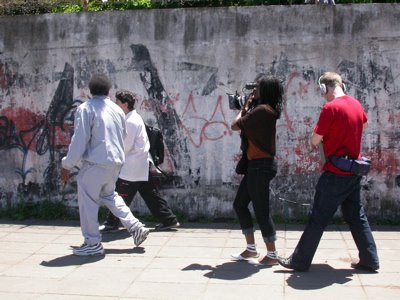
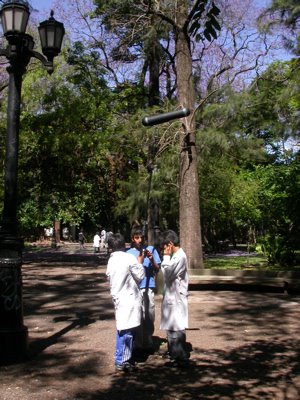
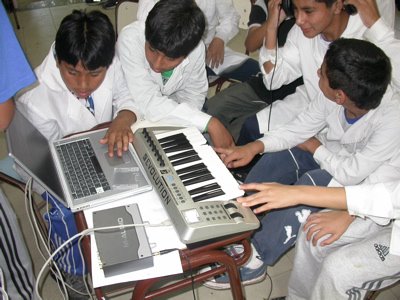
Some more screenings for the Journeys Across My City: Buenos Aires films:
Propeller TVTuesday 14th March
Same Difference Festival, Slough, 2nd April
East End Film Festival, London
April 29th
1st Homer International Film Festival for Children, Alaska
April 8th - 13th May
I'm particularly excited about the last one...
(photograph copyright Mark Raeburn and Redcurrent Films)
Sunday, January 15, 2006
Winter 2006 books
Culture and Pedagogy by Robin Alexander
Sweeping comparative study of primary education in five countries - taking a long view of the differences both at classroom and at policy level in national educational systems
Performance Studies: an introduction by Richard Schechner
Erudite and very, very useful summary of some of the key tenets of performance studies. An emergent classic.
Dialogic Inquiry: toward a sociocultural practice and theory of education by Gordon Wells
Hardcore theoretical look at inquiry-based learning, drawing particularly on Vygotsky and M.A.K.Halliday
Saturday, December 31, 2005
events and conferences that Graham contributed to in 2005
Building a Creative Learning Culture in Newham, Stratford Circus, 12th December 2005
Risky Business Symposium, Melbourne, Australia, 21st-22nd October 2005
NFER conference: Becoming a research-engaged school, London, 27th September 2005
International Association for the Study of Popular Music: Rome 2005 Conference, 25 - 30 July 2005
Exploring Internationalism seminar, London 2012, 22nd June 2005
University College Chichester staff development day, 15th June 2005
FORTE London meeting, 10th June 2005
Creative Learning Spaces, University of Greenwich, 25th April 2005
Design and Performance research cluster seminar, Hinckley, 21st April 2005

Subscribe to:
Posts (Atom)